
Purpose
This document provides a customer-facing overview of the sensor setup architecture used for IntelliAM Condition Based Monitoring (CBM). It explains how data is collected on site, how it is transferred securely to the IntelliAM platform, and the core hardware components involved.
High-level Architecture Overview
IntelliAM CBM uses a simple, proven flow:
- Sensors collect vibration and temperature measurements from selected assets.
- A local gateway receives sensor readings wirelessly.
- Data is transferred from site to the IntelliAM cloud platform via a dedicated 4G router.
- Data is ingested, stored securely, and made available for monitoring, trends, and analytics within IntelliAM.
This deployment approach is designed to be lightweight on site and can operate independently of a customer’s corporate network environment where required.
Security and Data Protection
IntelliAM is designed with security and data segregation as standard:
- Secure data transfer: Sensor data is transmitted to the IntelliAM platform using MQTTS (MQTT over TLS).
- TLS encryption protects data in transit.
- Secure storage: All sensor data is encrypted at rest.
- Customer segregation: Each customer’s data is logically separated within the IntelliAM platform.
- Cloud controls: Data storage encryption is provided using Microsoft Azure Storage encryption capabilities.
On-site Components (what is installed)
A Typical on-site installation includes:
A. Wireless sensors
- Installed directly on the monitored assets.
- Capture vibration and temperature data.
- Communicate wirelessly to the gateway using Bluetooth Low Energy (BLE).
B. Gateway (wireless network controller)
- Receives and manages data from the sensors.
- Performs initial signal processing (for example FFT and trend features, depending on configuration).
- Forwards data securely onwards for cloud ingestion.
C. 4G router (connectivity)
- Provides a dedicated cellular data link for transferring CBM data to the IntelliAM platform.
- Can be deployed outside of the customer network and managed independently, depending on customer requirements.
Device management and operational approach
Where a Teltonika router is used, IntelliAM manages the router fleet via Teltonika RMS, supported by additional internal tooling.
This provides:
- Controlled firmware management: Updates are tested on a staging device before being rolled out to the deployed fleet.
- Fleet visibility: IntelliAM can provide periodic reporting showing firmware versions across deployed devices.
- Out-of-band management: Connectivity hardware can be managed independently of the customer’s internal network.
Note: Specific router model and SIM approach may change depending on component availability and supply chain conditions.
Appendix A: Hardware details (technical reference)
A1. Cassia X2000 Bluetooth Gateway
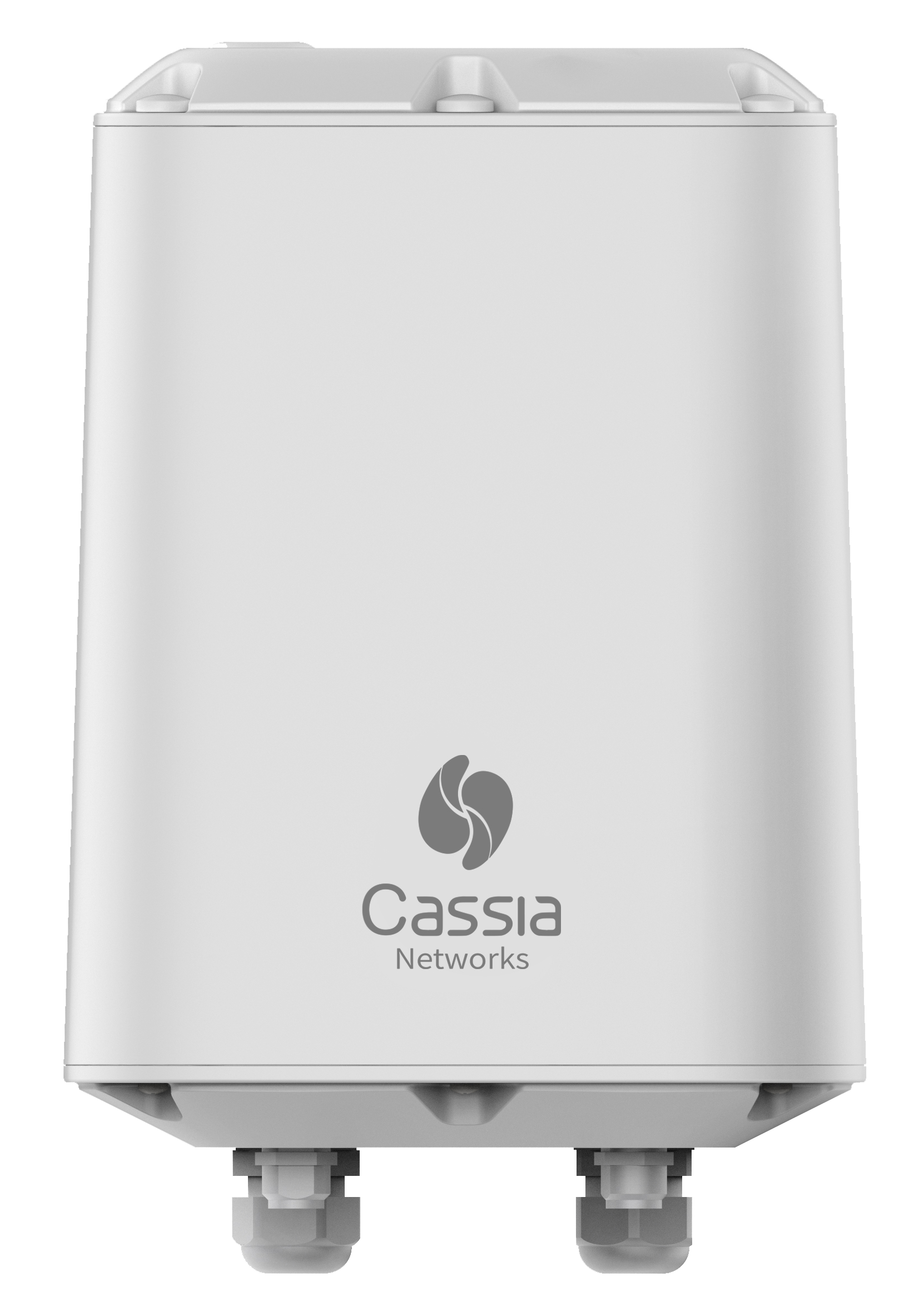
Device: ACCESS360 Series (ConnectBridge Wireless Gateway and Network Controller)
Key capabilities:Supports up to 40 concurrent Bluetooth Low Energy connections, with management capacity for up to approximately 2,000 BLE devices across the network.
Wireless communication: Bluetooth Low Energy 5.0 with long-range connectivity capabilities. Network connectivity via Ethernet and Wi-Fi, with Power over Ethernet (PoE) support.
Gateway features: long-range BLE coverage, remote device access, protocol forwarding, device filtering, edge connectivity, and centralised management through the Cassia Access Controller (AC). No embedded vibration analytics or onboard FFT processing.
Environmental and mechanical:
- Ingress protection: IP66
- Operating temperature: –40 °C to +65 °C
Compliance identifiers:
- FCC ID: 2AL7CC2000
- IC ID: 22541-X2000
Certificates and compliance:
FCC, CE, IC, RoHS compliant. Additional regional certifications available depending on deployment region.
A2. CTC sensor
Device: WS200 Series (ConnectSens Wireless Sensor – Single-Axis Dynamic Vibration + Temperature)
Key capabilities:
- Measures single-axis vibration and temperature.
- Wireless communication: Bluetooth Low Energy 5.2.
- Sensing structure: MEMS
Wireless range and autonomy:
- Line-of-sight range: up to 365 m (approx. 1,200 ft)
- Battery life: up to 4 years (configuration dependent)
Vibration performance:
- Sampling frequency: configurable, up to 25.6 kHz
- Dynamic range: configurable ±8 g, ±16 g, ±32 g, ±64 g
- Frequency response:
- 0.5 Hz to 10 kHz (+9.5/-6 dB)
- ±10% accuracy: 0.5 Hz to 1 kHz Sample resolution: 16-bit
Temperature performance:
- Range: –40 °C to +80 °C (reported in °C)
Environmental and mechanical:
- Ingress protection: IP67
- Shock protection: Powered: 5,000 g peak for 0.5 ms
- Unpowered: 10,000 g peak for 0.2 ms
- Weight: approx. 130 g Case: 316L stainless steel base with nylon cap
- Mounting: M6×1 male stud; supplied magnetic mounting
Certificates and compliance:
- SIL certificate available
A3. 4G router and SIM approach (preferred option)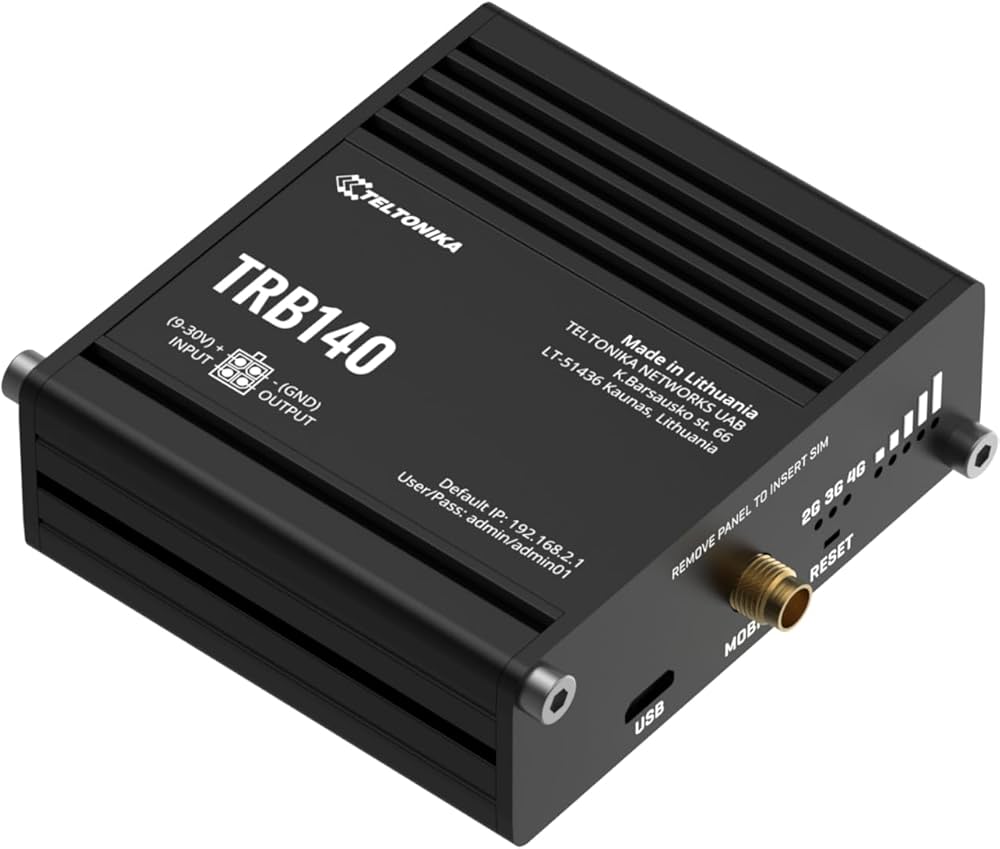
Device (typical): Teltonika TRB140 PoE (or equivalent industrial 4G/LTE router)
Core function:
- Provides a dedicated cellular WAN connection for transferring gateway data to the IntelliAM platform.
- Supports outbound-only connectivity for telemetry transfer (no inbound connectivity is required for data transfer).
Cellular connectivity:
- Mobile network: 4G/LTE (with fallback to 3G/2G where supported by local networks and regional variants).
- SIM capability: dual SIM and/or eSIM capability (model and region dependent).
- Roaming: SIM provider selected to support roaming as required by deployment geography.
- Antennas: external cellular antennas supported (connector type depends on router variant).
LAN and physical interfaces (typical):
- Ethernet LAN ports for gateway connectivity (count and speed depend on router variant; commonly 10/100 Mbps ports).
- WAN/LAN routing and NAT supported.
- DHCP server and DNS forwarding supported (typically enabled for a simple “plug-in gateway” installation).
- Firewall capabilities supported (stateful filtering and port control, configuration dependent).
Power and installation (typical):
- Power input: DC input (exact voltage range depends on router variant).
- PoE support: PoE functionality available on the PoE model (capability and mode depend on device variant).
- Mounting: DIN rail / wall mounting options supported (variant dependent).
- Operating environment: industrial-rated; final operating temperature and ingress protection depend on chosen model/variant.
Security and data transfer:
- Data transport: gateway-to-cloud transfer uses MQTTS (MQTT over TLS).
- Encryption: TLS used for data in transit.
- Connectivity model: outbound connections only; no inbound ports are required to be exposed for standard operation.
- Network separation: can be deployed independently of the customer corporate network where required.
Device management (where enabled):
- Fleet management platform: Teltonika RMS.
- Remote capabilities (policy dependent):
- device health monitoring (online/offline status, signal strength, data usage)
- configuration management
- controlled firmware updates
- remote troubleshooting (for example reboot and basic diagnostics)
- Update approach: staged updates are used (test on a staging device prior to broader customer rollout).
Notes
Router model, SIM provider, and exact specifications may vary by region, approvals, and component availability.
Comments
0 comments
Article is closed for comments.